There are moments when life asks us to stay. To stay with a feeling instead of scrolling past it. To stay with a breath instead of rushing ahead. To stay with ourselves instead of escaping the discomfort.
Most of us are very good at not staying. We distract. We power through. We check out when things feel too intense or too quiet. And that is not a failure. It is a nervous system doing its best to protect us.
But here is the gentle truth. The longer we can stay present, the more choice we have. Presence gives us space. And space gives us relief.
This week, we are planting a seed around why staying present longer matters, and how to build that capacity in small, doable ways.
🧠 Why
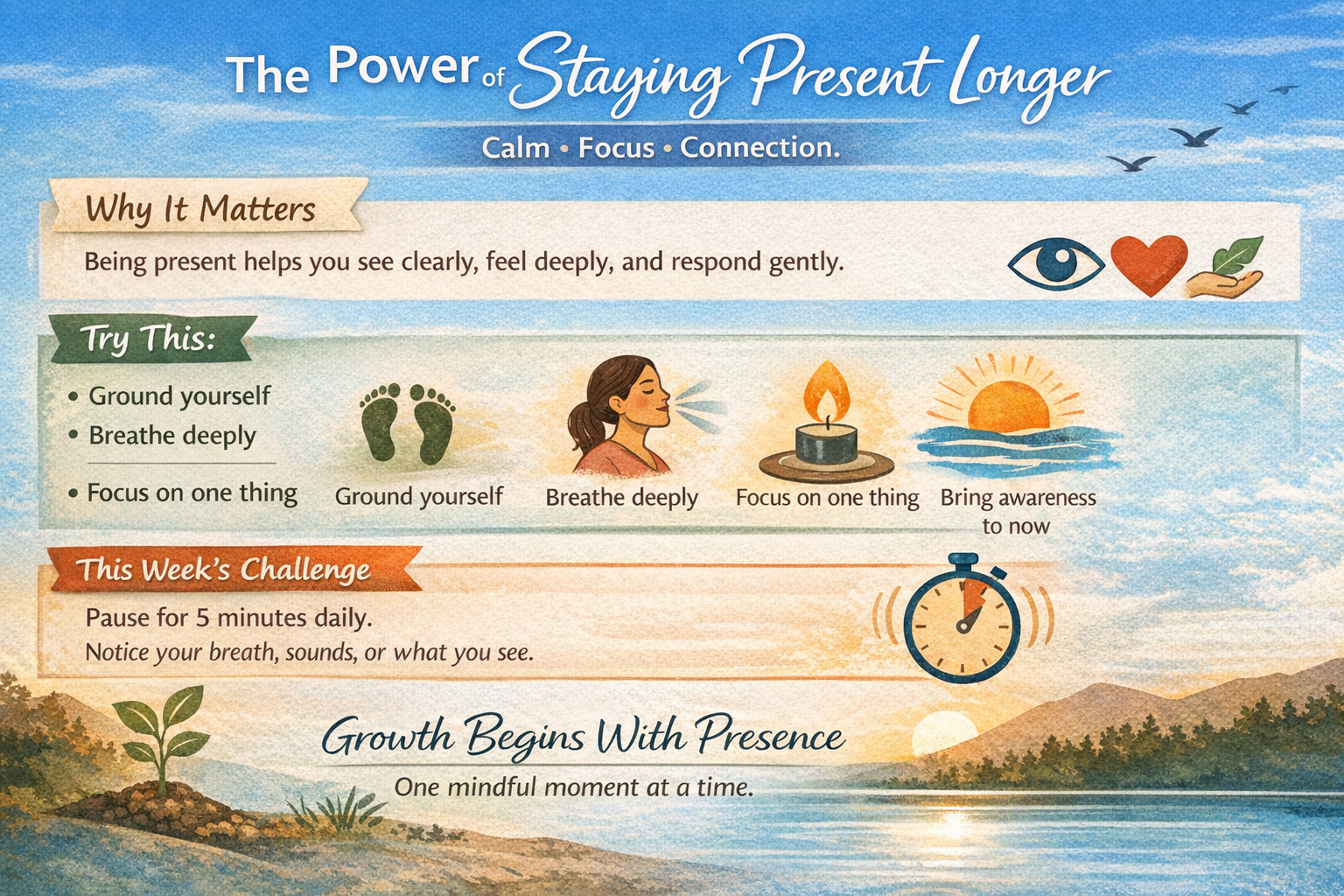
Staying present is not about forcing calm or emptying your mind. It is about learning how to be with what is already here without being swept away by it.
When we cannot stay present, we often skim the surface of our experience. We miss important signals from our body and emotions. Anxiety grows louder. Stress feels endless. Thoughts spiral because we do not stay long enough to see them change.
Presence works differently.
When we stay with an experience just a little longer than usual, something important happens. Our nervous system begins to settle. Our thoughts slow. Feelings move instead of getting stuck. We start to realize, I can handle this moment.
Staying present longer builds trust with yourself. It teaches your mind and body that you are safe enough to stay.
💡 What to Do Instead
Staying present is a skill. And like any skill, it works best when we build it gradually.
The key is not effort. The key is safety first.
Before asking your attention to focus, gently signal safety to your nervous system.
Step 1: Gladden and Ground (2–5 minutes)
Start by checking in with yourself.
Ask quietly, Am I safe enough right now to focus on one thing?
Then bring to mind one to three moments of goodness. This could be a moment of connection, kindness, integrity, or simple beauty. Nothing dramatic is required. Let your body feel what was good about it.
As you do this, allow your breath to deepen naturally. Feel your feet on the floor or your body supported by the chair.
This step matters. A soothed nervous system is far more willing to stay present.
Step 2: Narrow Gently (5–15 minutes)
Choose one simple anchor and let your attention rest there.
Some options you might try:
- Feeling the breath only at the tips of your nostrils • Receiving sounds at the ears without chasing them • Gently resting your eyes on a single dot or object • Repeating a quiet phrase like “safe,” “at ease,” or “here” • Imagining a small candle flame or soft light in the center of your belly • Placing attention on the heart area and sensing care or gratitude
If it helps, you can softly count exhales from one to ten and then back to one. Keep it light. Precision without pressure.
When your mind wanders, return gently. Again and again. That returning is the practice.
Step 3: Open Wisely (optional)
Once you feel a bit steadier, you may choose to open your awareness to whatever arises. Thoughts, emotions, sensations. If you drift into daydreaming, return briefly to your anchor and then open again.
We are not suppressing experience. We are strengthening our ability to stay.
📅 This Week’s Wellness Challenge
Practice staying present just one breath longer than usual.
Choose one anchor and practice for 5 minutes a day this week.
Your accountability check:
At the end of each practice, ask yourself:
Was I able to stay a little longer than yesterday?
That is enough. Progress is measured in moments, not perfection.
🌱 Growing Through Awareness
Staying present longer changes us quietly. It softens reactivity. It builds resilience. It helps us meet our lives with more compassion and less fear.
You do not need to master mindfulness. You only need to stay, just a little longer than before.
Growth begins with safety. With kindness. With the willingness to remain.
Plant the seeds to succeed. Presence grows one moment at a time.