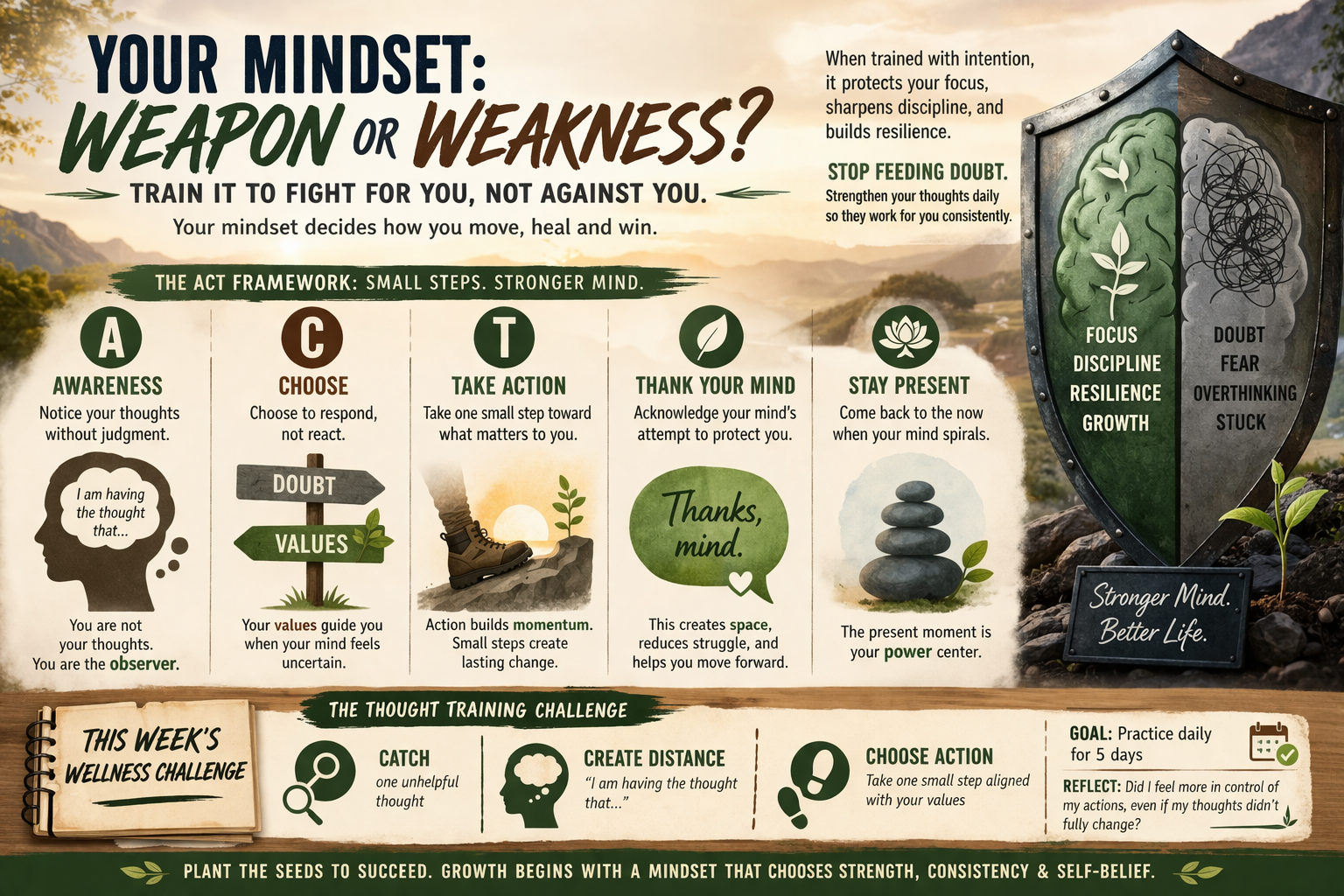
There are moments in life when everything feels heavier than it should. The same situation can either break your momentum or build your strength. The difference is not always the circumstance. Mindset training can help change the story your mind tells you about it. Indeed, adopting mindset training helps you navigate life’s challenges more effectively.
Two people can walk through the same challenge. One walks away defeated, questioning their worth. The other walks away grounded, even if it was hard, believing they can handle what comes next, especially if they’ve practiced mindset training.
The separating line is not talent, luck, or even circumstances. It is mindset. Importantly, having consistent mindset training distinguishes the outcomes for many people.
Your mind is always working. The question is, is it working for you or against you? Developing your capacity through training your mindset clarifies your mental awareness and ability to choose helpful thoughts.
Mental Health Awareness Month is a powerful reminder that we do not just take care of our emotions. We train how we relate to them. Because when your mindset is intentional, it becomes a source of strength. When it is untrained, it can quietly become your biggest obstacle. That’s why mindset training is so valuable for emotional resilience.
The good news is this. Your mindset is not fixed. It is a skill. And like any skill, it can be strengthened through consistent exercises for mindset training.
🧠 Why
Our brains are wired for survival, not necessarily for confidence or clarity. This means we naturally scan for threats, replay mistakes, and hold onto self doubt longer than encouragement. As a result, mindset training gives us tools to work with our natural responses.
In Acceptance and Commitment Therapy (ACT), the focus is not on eliminating negative thoughts. It is on changing your relationship with them, and that’s where mindset training can help change your patterns.
When we treat every thought as truth, especially the critical or fearful ones, our behavior begins to shrink. We avoid. We hesitate. We second guess ourselves. Setting aside time for mindset training interrupts this cycle.
But when we learn to step back and observe our thoughts instead of being controlled by them, something shifts. We create space. And in that space, we gain choice. A key outcome of mindset training is building that ability to observe and choose.
That choice is where resilience, discipline, and healing begin. Mindset training always focuses on nurturing these skills for the future.
💡 What to Do Instead
Here are simple, practical ACT based tools to help train your mindset so it supports you instead of sabotages you. Practicing these tools can shift your mental habits, which is core to mindset training.
-
Name the Thought Instead of Becoming It
When a negative thought shows up, try this subtle shift:
Instead of
“I am not good enough”
Say
“I am having the thought that I am not good enough”
This creates distance between you and the thought. You are no longer the thought. You are the observer of it, and with mindset training, you practice making this distinction daily.
Practice it daily:
Catch one unhelpful thought and rephrase it this way to reinforce your mindset training routine.
-
Thank Your Mind
This may feel strange at first, but it is powerful.
When your mind offers fear or doubt, respond with
“Thanks, mind”
This acknowledges that your brain is trying to protect you, even if it is not helpful in the moment. It reduces the internal struggle and helps you move forward anyway. Such responses are developed through consistent mindset training exercises.
Practice it daily:
Use this phrase at least once when self doubt shows up. With repetition, mindset training will make this second nature.
-
Move Toward What Matters (Values Over Feelings)
Your feelings will fluctuate. Your values are your anchor, especially when applying mindset training to decision-making.
Ask yourself
“What kind of person do I want to be in this moment?” This powerful question is used often in mindset training literature.
Even if you feel anxious, you can still choose to be present, kind, or committed. That’s one benefit of consistent mindset training practices.
Break it down:
Choose one value for the day
Take one small action that aligns with it. This small focus is at the heart of practical mindset training routines.
Example
Value: Growth
Action: Start the task you have been avoiding for 5 minutes. Each step like this reinforces your mindset training journey.
-
Take One Committed Step
Discipline is not built through intensity. It is built through consistency. This core principle comes from most leading mindset training models.
Instead of waiting to feel motivated, take one small step forward anyway. This way, mindset training reshapes your habits over time.
This rewires your brain to associate action with progress, not perfection. Practicing mindset training daily makes this shift more sustainable.
Keep it simple:
One email
One workout set
One honest conversation. These are all small acts of mindset training in action.
Small steps create momentum and strengthen mindset training effects every day.
-
Ground Yourself in the Present Moment
When your mind spirals, bring it back to now. One way to do that is through mindset training focused on mindfulness exercises.
Try this quick reset
Name 5 things you can see
4 things you can feel
3 things you can hear. These are easy introductions to mindfulness and mindset training for beginners.
This interrupts overthinking and brings your nervous system back to a regulated state, demonstrating the practical power of mindset training for stress.
📅 This Week’s Wellness Challenge
The Thought Training Challenge
For the next 5 days, choose one moment each day to practice noticing and shifting your thoughts. This structured approach is a helpful introduction to daily mindset training programs.
Your action steps:
Catch one unhelpful thought
Create distance by saying “I am having the thought that…”
Choose one small action aligned with your values anyway. These steps are core exercises in many mindset training routines.
Your measurable goal:
Practice this at least once per day for 5 days to get the full effect of mindset training strategies.
Your reflection prompt:
At the end of the week, ask yourself
Did I feel more in control of my actions, even if my thoughts did not fully change? Reflecting is an important part of mindset training’s growth process.
🌱 Growing Through Awareness
Your mind will always generate thoughts. That is what it is designed to do. But you get to decide which thoughts you listen to, which ones you challenge, and which ones you let pass. This skill is central to all forms of mindset training.
Strength is not the absence of doubt. It is the ability to keep moving forward even when doubt is present. In fact, those who dedicate time to mindset training learn to do this more often.
When you train your mindset with intention, it becomes a steady ally. It protects your focus. It sharpens your discipline. It reminds you who you are when things feel uncertain. Finally, remember that mindset training is a lifelong journey toward self-mastery.
You do not need to silence your mind to become stronger. You just need to stop letting it lead without direction. Over time, mindset training offers practices that help you guide your mind productively.
Plant the seeds to succeed.
Growth begins with learning to stand beside your thoughts instead of being controlled by them. By investing in consistent mindset training, your personal growth will flourish.