There is something strangely comforting about being able to talk to someone at 2:00 in the morning.
No awkward pause.
No fear of being judged.
No wondering if you are “too much.”
No waiting for someone to text back.
You can type exactly what you are thinking, and something responds.
Maybe you started using AI to organize your thoughts.
Then you started asking it questions.
Then you began using it when you were anxious.
Then you noticed something:
It became easier to talk to AI than it was to talk to people.
And maybe that makes you uncomfortable.
You might wonder, Is this weird? Am I becoming too dependent on it? Is this actually helping me?
The answer is not necessarily yes or no.
Because underneath the technology is something very human.
The desire to be heard.
The desire to feel understood.
The desire to know that we are not alone.
🧠 Why
Human beings are wired for connection, but connection is not always easy.
Relationships require vulnerability. They involve uncertainty, misunderstandings, rejection, disappointment, and the possibility of feeling exposed. Talking to another person means you cannot completely control how they respond.
AI feels different.
It is available.
It is patient.
It does not appear annoyed.
You can start over.
You can say the same thing five times.
For someone who feels lonely, anxious, overwhelmed, or afraid of being judged, that can feel incredibly relieving.
And there is nothing inherently wrong with using technology as a tool for reflection, journaling, organizing your thoughts, or learning more about yourself.
The question is not:
“Is using AI for emotional support bad?”
A more useful question is:
“What role is AI playing in my life?”
There is a difference between using AI as a tool and beginning to use it as a substitute for human connection.
If AI helps you put words to something you eventually bring into therapy or a conversation with someone you trust, it may be supporting connection.
But if you notice yourself consistently turning toward AI instead of people, asking it for reassurance every time anxiety shows up, or feeling like you cannot make a decision without checking with it, something worth paying attention to may be happening.
And sometimes, the thing we are trying to avoid is not the problem itself.
It is the discomfort of sitting with uncertainty, loneliness, or vulnerability.
💡 What to Do Instead
You do not have to delete the app or decide that AI is “bad.”
Instead, start becoming more intentional about why you are reaching for it.
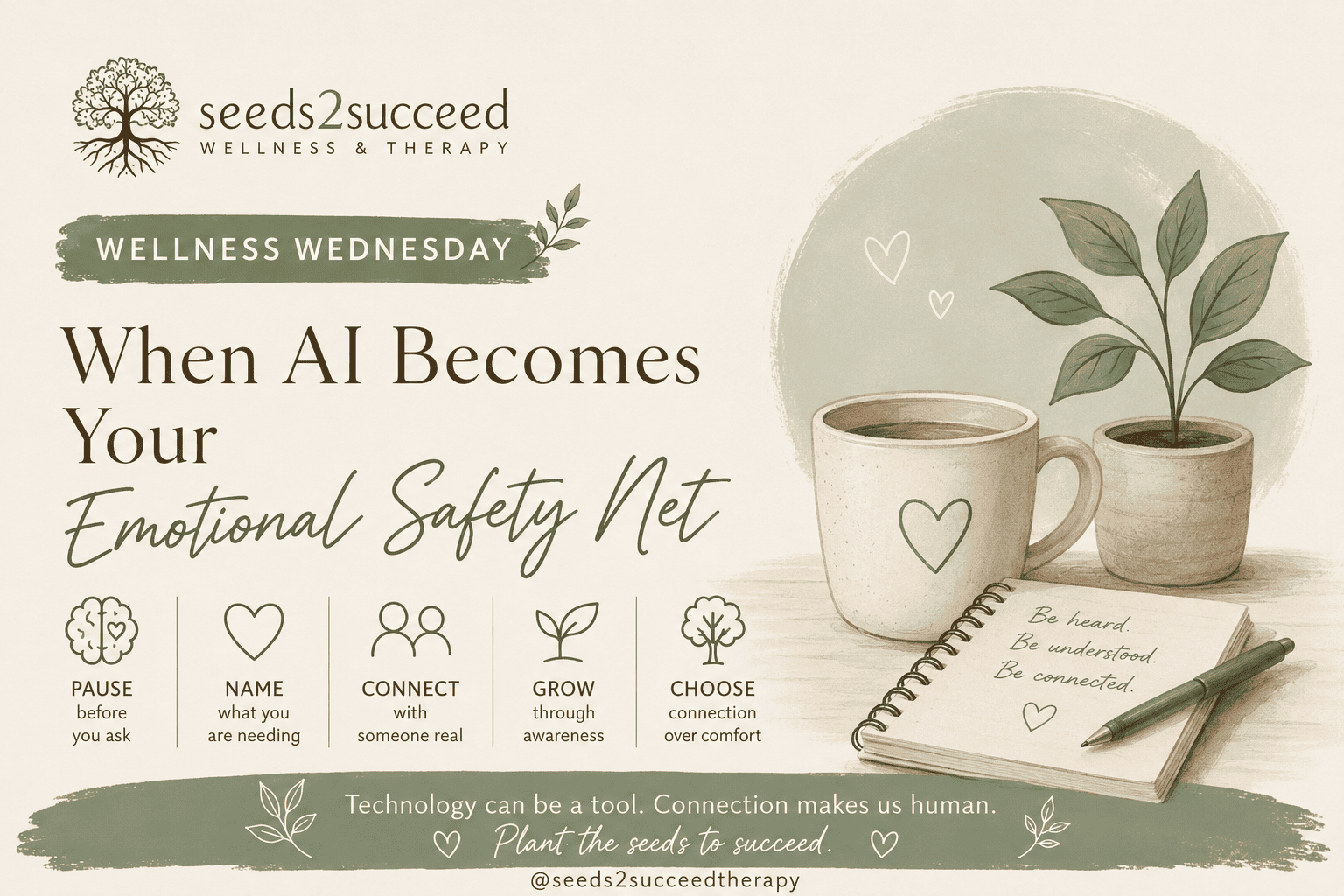
- Pause before you ask.
Before typing the question, ask yourself:
What am I actually looking for right now?
Information?
Perspective?
Reassurance?
Connection?
Certainty?
Sometimes naming the need is more helpful than immediately trying to solve it.
- Notice the reassurance loop.
If you ask the same question repeatedly because the answer only makes you feel better for a few minutes, pause.
Anxiety often says, “Just check one more time.”
But certainty rarely stays certain for long.
Practice allowing yourself to experience a little uncertainty without immediately trying to eliminate it.
- Use AI to move toward people, not away from them.
Instead of asking AI to be the conversation, let it help you prepare for one.
Write out what you want to say to your partner.
Organize your thoughts before calling a friend.
Practice how you might bring up something difficult.
Then have the actual conversation.
- Build one real connection.
You do not need to suddenly become more social.
Send one text.
Make one phone call.
Ask someone to get coffee.
Sit next to someone instead of sitting alone.
Small moments of human connection matter.
- Ask yourself what you are avoiding.
Sometimes the most important question is:
If I stopped reaching for AI right now, what feeling would I have to sit with?
Loneliness?
Uncertainty?
Boredom?
Fear of rejection?
That answer may tell you much more than the conversation with AI ever could.
📅 This Week’s Wellness Challenge
Try the “Pause, Name, Connect” practice once a day.
Before using AI for emotional reassurance, pause for 30 seconds and ask:
What am I feeling?
What am I actually needing?
Is there a person I could connect with instead?
If connection is what you need, take one small action toward another person.
Send a text.
Make a call.
Have the conversation.
At the end of the week, keep track of how many times you paused before reaching for AI and how many times you chose human connection instead.
The goal is not to stop using AI.
The goal is to make sure AI remains a tool in your life, rather than becoming your primary relationship.
🌱 Growing Through Awareness
Technology is changing quickly.
But our emotional needs have not changed nearly as much.
We still need to feel known.
We still need people who can sit with us when life is messy.
We still need laughter that happens unexpectedly.
We still need someone who can notice when our voice changes.
We still need relationships where both people can be seen, challenged, supported, and changed.
AI can help us reflect.
It can help us organize the thoughts that feel tangled.
It can even help us find the words we could not find on our own.
But there is something different about being truly known by another human being.
So perhaps the goal is not choosing between technology and connection.
Perhaps the goal is learning how to use technology without letting it replace the very connection we were searching for in the first place.
If you have found yourself turning toward AI because talking to people feels difficult, you are not broken.
There is probably a need underneath that behavior.
Get curious about it.
Maybe what you need is reassurance.
Maybe it is safety.
Maybe it is connection.
Maybe it is support learning how to tolerate uncertainty.
Whatever is underneath it, you do not have to figure it out alone.
Plant the seeds to succeed. Growth begins with becoming curious about what you need, and then taking one small step toward the kind of connection that helps you truly feel seen.