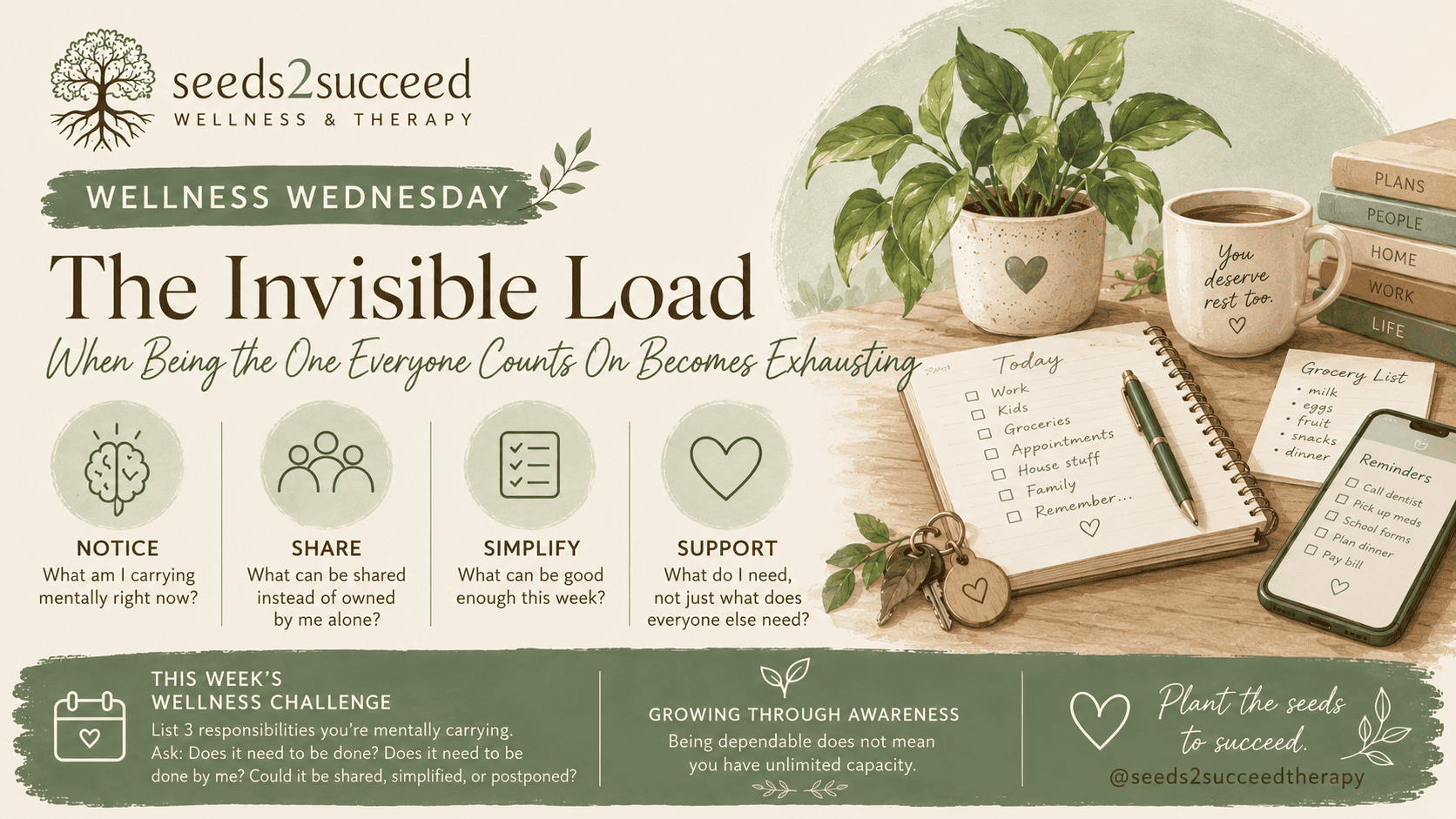
When Being the One Everyone Counts On Becomes Exhausting
Who remembers when everyone has an appointment?
Who notices when the groceries are running low?
Who keeps track of birthdays, school events, family schedules, holiday plans, and everything else that needs to get done?
And who makes sure everyone else is okay?
For some people, the answer is almost always the same.
You.
Not because anyone necessarily asked you to take on every responsibility.
Sometimes, it just happened.
You became the organized one. The dependable one. The person who remembers, anticipates, plans, checks in, and makes sure nothing falls through the cracks.
And while being someone others can count on can feel meaningful, it can also be exhausting.
Especially when so much of what you do goes unnoticed.
This is the invisible load.
And sometimes, the hardest part isn’t everything you’re doing.
It’s everything you’re carrying in your head.
🧠 Why
We tend to think of responsibilities in terms of physical tasks.
Making dinner. Driving the kids. Running errands. Cleaning the house. Managing work.
But there’s another layer that doesn’t always get recognized.
The mental and emotional work behind those tasks.
Remembering what needs to happen. Anticipating problems. Keeping track of everyone’s needs. Making decisions. Coordinating schedules. And feeling responsible when something gets missed.
This is often called the mental load, and it can overlap with emotional labor.
The mental load is not just doing the work. It’s being the person who notices the work needs to be done in the first place.
And that responsibility doesn’t necessarily disappear when the task is finished.
You might be sitting on the couch, but your mind is still organizing tomorrow.
You might be enjoying dinner, but you’re already thinking about what needs to happen next week.
You might finally have a free afternoon, but instead of relaxing, you’re mentally reviewing everything you haven’t gotten to.
Over time, this constant sense of responsibility can contribute to emotional exhaustion, irritability, resentment, and difficulty relaxing.
The holiday season can magnify it.
Suddenly, the usual responsibilities are joined by gifts, gatherings, travel plans, school celebrations, family expectations, and pressure to make everything feel special.
And often, the people working hardest to create those moments are the ones with the least opportunity to enjoy them.
Here’s something worth considering:
Being capable of handling everything doesn’t mean everything should be yours to handle.
💡 What to Do Instead
You don’t necessarily need a completely different schedule.
You may need a different relationship with responsibility.
- Notice what you’re carrying.
For one day, pay attention to the responsibilities that exist primarily in your head.
Not just the tasks you complete, but the things you’re remembering, anticipating, and coordinating.
Ask yourself:
What am I mentally keeping track of that no one else even realizes needs attention?
Sometimes identifying the invisible work is the first step toward changing how it’s shared.
- Separate helping from owning.
There’s a difference between helping with a responsibility and being fully responsible for making sure it happens.
If you always remind someone, organize the details, and follow up afterward, you may still be carrying the task even when someone else completes it.
Consider what it would look like to share ownership rather than simply delegate individual steps.
- Practice asking directly.
People may not recognize how much you’re managing unless you communicate it.
Instead of waiting until you’re frustrated, try:
“I have a lot on my plate right now, and I could use some help coordinating things.”
Or:
“Could you take responsibility for planning that this year?”
You don’t have to justify needing support by reaching your breaking point first.
- Let some things be good enough.
Not everything needs to be perfectly planned, beautifully organized, or completed the way you’ve always done it.
Some traditions can be simplified.
Some invitations can be declined.
Some responsibilities can wait.
And some things can be done differently without being done incorrectly.
- Make room for your own needs.
If you’re always checking in on everyone else, when was the last time you checked in with yourself?
What do you need?
What feels heavy?
What would help you feel supported?
Your needs don’t become less important simply because you’re good at meeting everyone else’s.
📅 This Week’s Wellness Challenge
Try an Invisible Load Check-In.
Take five minutes and write down three responsibilities you’ve been mentally carrying.
For each one, ask:
- Does this actually need to be done?
- Does it need to be done by me?
- Could this responsibility be shared, simplified, or postponed?
Choose one small change.
Maybe you ask someone else to coordinate a family plan.
Maybe you let a task wait until tomorrow.
Maybe you communicate a need you’ve been keeping to yourself.
The goal isn’t to stop caring for others.
It’s to recognize that caring for others shouldn’t consistently require neglecting yourself.
🌱 Growing Through Awareness
There’s something meaningful about being dependable.
About showing up.
About being someone people trust.
But there’s a difference between being reliable and feeling responsible for everything.
You can love your family and still need help.
You can be good at your job and still have limits.
You can care deeply about others and still protect your own energy.
You don’t have to wait until you’re completely exhausted to acknowledge that something needs to change.
Sometimes growth looks like doing more.
And sometimes it looks like recognizing what was never yours to carry alone.
Plant the seeds to succeed. Growth begins when you recognize that your needs deserve consideration, too.